
By James Shannon August 15, 2026
Selling at a farmers market in Carlisle, a festival in Harrisburg, a craft fair near State College, or a fundraising event at a local fire hall can look simple from the customer side. A vendor sets up a table, displays products, takes payments, and packs up at the end of the day.
Behind the table, however, temporary-event commerce involves several moving parts. Vendors may need to deal with organizer rules, municipal requirements, Pennsylvania sales tax registration, food licensing, payment connectivity, card-security practices, cash controls, power limitations, and end-of-day reconciliation.
Before selling at a farmers market, fair, festival, or fire-hall event, a vendor should confirm event approval, applicable state and local permits, sales-tax obligations, food-service requirements where relevant, payment connectivity, backup payment options, and secure cash-handling procedures.
The exact requirements depend on what you sell, where the event takes place, how food is prepared or served, whether the products are taxable, which government agency has jurisdiction, and what the organizer requires.
That distinction matters. An acceptance email from a farmers market manager does not necessarily function as a government business license. A Pennsylvania sales tax account does not replace a municipal vending permit.
And a craft seller displaying handmade goods generally faces different food-safety requirements than a concession operator preparing meals under a tent.
For payment processing for farmers markets, preparation is equally important. A terminal that works perfectly inside a store may struggle at a crowded fairground where thousands of phones compete for cellular capacity. Venue Wi-Fi can disappear during peak hours, batteries can run down, and card transactions that appear to be queued offline may eventually be declined.
A successful event setup therefore treats permits, connectivity, card acceptance, cash handling, and reconciliation as one operating system rather than separate afterthoughts.
What Vendors Need Before Accepting Payments at an Event
Start preparing well before loading tables, inventory, tents, and coolers into the vehicle. Your objective is to determine which requirements apply to your particular business and event rather than collecting every permit that exists.
A practical farmers market vendor checklist should cover both compliance and operations:
- Organizer application or written vendor approval
- Business registration, if applicable to the business structure
- Pennsylvania tax registration when taxable sales require it
- Local municipal vendor license or temporary retail authorization, if applicable
- Food facility approval or licensing when required
- Required insurance documentation
- Approved payment terminal or mobile POS
- Cellular, Wi-Fi, or hotspot connectivity
- Backup payment method
- Starting cash float and secure cash storage
- Receipt capability
- Phone, terminal, and hotspot charging equipment
- Refund procedures
- End-of-day reconciliation records
Treat organizer requirements and government requirements as separate checkpoints. Event organizers may request proof of insurance, booth fees, photographs, menu information, electrical requirements, tent specifications, or food licenses as conditions of participation.
Those conditions do not automatically determine whether a borough, township, state agency, or local health authority has additional requirements.
Pennsylvania also does not have one universal business license that every business obtains simply because it is operating in the Commonwealth. Licensing can depend on the activity being performed. Pennsylvania’s Business One-Stop guidance specifically notes that business licensing requirements vary with the type of business activity.
For vendors, that makes location-specific research important. A seller who attends recurring markets in Cumberland County and then signs up for a festival in Centre County should not assume the exact same approval process applies at both locations.
Central PA Vendor Permits: What Should You Check?

There is no universal “Central PA vendor permit.” Central Pennsylvania includes cities, boroughs, townships, and counties with different ordinances and administrative procedures, so a vendor should check the rules for the exact municipality where sales will occur.
Possible local requirements include a temporary retail license, transient retail permit, peddler or solicitor license, special-event vendor approval, zoning authorization, or event-specific permit. Whether one applies depends on the municipality, the nature of the sales activity, the location, and sometimes the structure of the event.
State College provides a useful example of why local research matters. The Borough states that a business operating from a stationary location temporarily must obtain a Temporary Retail Dealers license, and its official Arts Festival guidance requires applicable sidewalk-sale exhibitors to obtain the Borough’s temporary retail authorization.
That does not mean every borough in Central PA uses a Temporary Retail Dealers license. It demonstrates the opposite: municipal rules can be specific to the location.
Before an event, identify:
- The municipality containing the venue
- Whether temporary retail sales require local registration or licensing
- Whether the organizer obtained any umbrella event permits
- Whether those permits actually cover individual vendors
- Whether food vendors need separate health or fire approvals
- Whether there are restrictions on signs, tents, propane, generators, or sidewalk vending
- Whether a particular license must be displayed at the booth
A local municipal vendor license in Central PA should therefore be verified directly with the appropriate borough, township, city, or event office.
Never assume that organizer approval substitutes for an individual government requirement. Conversely, do not assume that because one neighboring municipality requires a temporary retail license, the municipality hosting your next event requires the same thing.
Pennsylvania Temporary Retail Food Facility Requirements
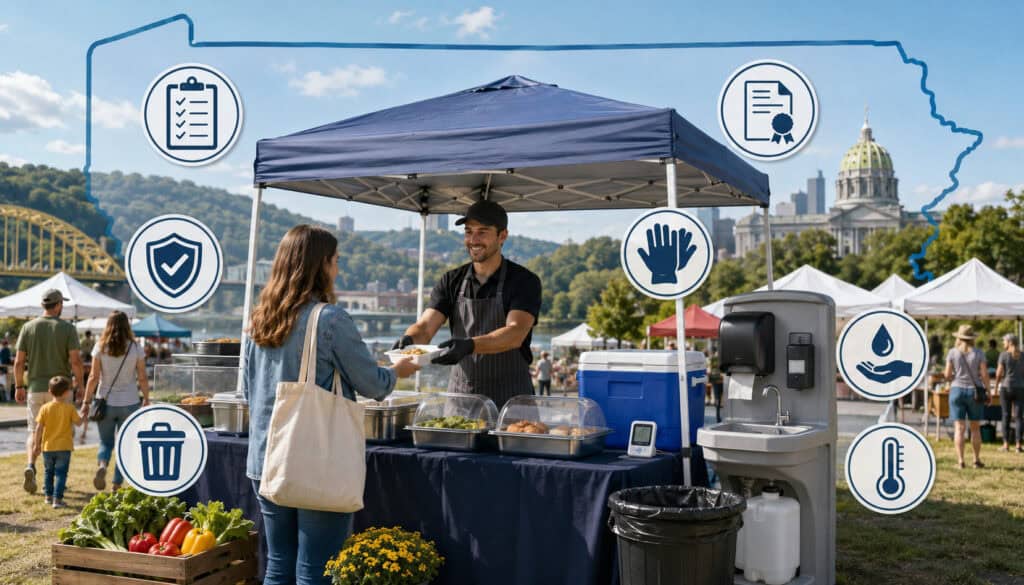
Food sellers deserve special attention because food licensing and ordinary vendor registration serve different purposes. A permit allowing someone to sell merchandise at an event does not automatically authorize food preparation or service.
The Pennsylvania Department of Agriculture’s guidance for mobile food facilities, fairs, and temporary events describes a Temporary Event License for a retail food facility operating at a fixed location in connection with an event or celebration for no more than 14 days.
It separately describes a Temporary Food Facility License for certain facilities operating no more than 14 days in a calendar year outside an event or celebration.
The important point is that the Pennsylvania temporary retail food facility permit question depends on the operation, jurisdiction, and type of activity. Vendors should not decide they are exempt simply because an event lasts one weekend.
The Department’s broader retail food guidance also identifies certain licensing exemptions within PDA jurisdiction, including qualifying operations that operate no more than three days per calendar year, sell only specified commercially packaged shelf-stable foods, or sell only raw agricultural commodities.
Even when a facility qualifies for an exemption from the PDA license requirement, the Department explains that it remains subject to inspection and other provisions of the law. Local health jurisdictions may use different requirements.
Food Preparation, Temperature Control, and Sanitation
Temporary food operations must think beyond the license application. The physical booth has to support safe food handling.
Depending on the menu and operation, regulators may evaluate handwashing, food protection, equipment sanitation, potable water, wastewater handling, employee hygiene, cooking procedures, and the ability to keep time/temperature controlled for safety foods within required temperature ranges.
Pennsylvania’s retail food program operates under the Commonwealth’s adopted Food Code framework, and the Department emphasizes correct food holding, employee hygiene, approved food sources, and other foodborne-illness controls.
For a concession stand preparing sandwiches, barbecue, hot foods, or refrigerated items, this can mean significantly more preparation than a vendor selling sealed shelf-stable products.
Before the event, determine:
- Where food will be prepared
- How cold products will remain properly refrigerated
- How hot products will remain properly held
- How temperatures will be checked
- Where employees will wash their hands
- Where potable water comes from
- Where wastewater can legally be disposed of
- How food and single-use items will be protected
- How utensils and food-contact surfaces will be cleaned
- What the inspector will expect to see before service begins
Do not wait until opening morning to discover that the booth lacks a required handwashing setup, approved water source, or appropriate temperature-control equipment.
Department of Agriculture Food Vendor PA Jurisdiction
The Pennsylvania Department of Agriculture regulates many retail food facilities, including farmers market food vendors, mobile food businesses, and temporary-event operations. But it is not the licensing authority for every food seller at every location.
The Department specifically explains that some Pennsylvania counties and municipalities operate their own retail food inspection and licensing programs.
Vendors are directed to determine which authority has jurisdiction over the location and to contact the appropriate local health department when the event is outside PDA jurisdiction. The state also warns that there is no automatic reciprocity between PDA and local health jurisdictions.
This creates an important operational rule: verify the jurisdiction for the event site itself.
If a bakery normally operates under one authority but attends a temporary event in another jurisdiction, the vendor should ask whether additional notification, licensing, or approval is required there.
Craft Vendors vs. Food Vendors: Do Not Treat the Requirements as Identical
A jewelry maker, produce grower, bakery, barbecue stand, candle seller, and food truck can all occupy adjacent booths while operating under very different regulatory requirements.
Event approval is usually relevant to everyone because the organizer controls participation. Sales-tax registration depends on the products or services being sold and the seller’s tax obligations.
Food licensing, by contrast, generally centers on food operations and does not automatically apply to a craft booth simply because the booth happens to be at a farmers market.
Use the following comparison as a screening tool rather than a substitute for agency guidance.
| Requirement | Craft/Retail Vendor | Prepared Food Vendor |
| Event approval | Usually required by organizer | Usually required by organizer |
| Local vendor license | May apply depending on municipality | May apply depending on municipality |
| Pennsylvania sales-tax registration | Depends on taxable sales and registration obligations | Often relevant when taxable prepared food is sold |
| Food facility license/permit | Generally not applicable to non-food merchandise | May be required depending on operation and jurisdiction |
| Health inspection | Generally not applicable to ordinary crafts | May apply |
| Payment setup | Needed if accepting electronic payments | Needed if accepting electronic payments |
| Insurance | Depends on organizer/venue/business | Often requested; requirements vary |
| Food-safety controls | Not normally applicable | Can include temperature, handwashing, food protection, water and waste controls |
There can also be important distinctions within the “food vendor” category. A farmer selling qualifying raw agricultural commodities is not necessarily regulated the same way as a vendor preparing ready-to-eat meals. A seller offering sealed shelf-stable products may face a different licensing analysis than someone cooking poultry or handling refrigerated foods.
Likewise, crafts cannot all be treated as one tax category. Pennsylvania exempts some categories of tangible goods while taxing many others, so the seller has to determine the taxability of the actual merchandise.
The safest workflow is to classify the business by activity before looking for permits: What are you selling? Are you preparing or serving food? Where are you selling it? Is the product taxable? Is the operation mobile, temporary, recurring, or fixed?
That produces more accurate answers than searching for a generic “farmers market permit.”
Pennsylvania Sales Tax for Event Vendors
Temporary selling does not automatically make a transaction tax-free. Pennsylvania’s Department of Revenue states that businesses selling taxable goods and services must register to collect applicable sales tax. Registration for sales, use, and hotel occupancy tax accounts is handled through Pennsylvania’s myPATH business tax registration process.
Pennsylvania’s general state sales tax rate is 6 percent. The Department identifies additional local sales taxes in Philadelphia and Allegheny County; ordinary Central PA event sales generally do not fall in those two local-tax jurisdictions. Taxability still depends on what is being sold and the circumstances of the transaction.
The payment method does not change whether a sale is taxable. A taxable $30 purchase remains a taxable transaction whether the buyer hands you cash, taps a phone, inserts a debit card, or uses another accepted payment method.
Similarly, sales tax and card-processing fees are different concepts. Sales tax is an amount a registered seller may be required to collect from the customer and remit to the government. Merchant processing fees are commercial charges associated with accepting electronic payments.
PA Sales Tax License for Craft Vendors
A craft vendor should determine whether the items being sold are taxable rather than assuming the word “handmade” creates an exemption.
Pennsylvania’s Department of Revenue says businesses selling taxable goods and services must register to collect sales tax. The Commonwealth’s business-registration system includes Sales, Use, and Hotel Occupancy Tax registration and, where applicable, a Transient Vendor Certificate.
A Pennsylvania-based artisan selling taxable merchandise may therefore have registration and collection obligations even if sales take place only at weekend markets or seasonal craft fairs.
Out-of-state vendors should pay particular attention to Pennsylvania’s transient-vendor rules. The state’s business registration wizard identifies the Transient Vendor Certificate as relevant in certain circumstances when an out-of-state sole proprietor or partnership without a permanent Pennsylvania location physically sells tangible personal property in the Commonwealth.
Vendors should use their actual business structure and activities when determining which registration applies.
What Products Are Taxable?
Taxability should be checked by product rather than by event type. Pennsylvania states that sales tax generally applies to retail sales of tangible personal property and specified services, while major exemptions include food that is not ready-to-eat, candy and gum, and most clothing.
Prepared-food operations have different considerations. Department of Revenue guidance says sales of food and nonalcoholic beverages by an eating establishment are generally taxable and specifically includes fairs, carnivals, food trucks, lunch carts, and similar operations within its discussion of eating establishments.
A vendor should therefore verify the treatment of:
- Handmade crafts and décor
- Artwork
- Clothing and accessories
- Prepared meals
- Bakery items
- Packaged foods
- Produce and agricultural products
- Candy
- Nonalcoholic beverages
- Services bundled with merchandise
Configure the POS only after determining which products should have tax applied. A poorly configured tax button can create dozens or hundreds of incorrect transactions before anyone notices.
Farmers Market Payment Processing Options
Good farmers market payment processing should make checkout fast without making the business dependent on one device or one network.
Common event vendor payment methods include:
- Cash
- Credit cards
- Debit cards
- Contactless cards
- Mobile wallets
- Approved QR-based payment methods
- A combination of electronic payments and cash
Accepting more payment methods can reduce situations where a customer wants to buy but cannot use the vendor’s preferred method. It also increases the importance of reconciliation because card sales, digital transactions, cash, refunds, tips, tax, and discounts need to reach one accurate event total.
For vendors using phones or tablets, mobile payment processing can provide a lightweight alternative to a full countertop system. Mobile setups can be useful at farm stands, craft booths, pop-ups, concession stations, and other businesses where checkout needs to move with the seller.
A more complete point-of-sale system can add item catalogs, sales reporting, inventory tracking, discounts, employee controls, and reconciliation features. Those functions become especially useful when several staff members are taking orders simultaneously.
Portable Credit Card Terminals
A portable credit card terminal can range from a small reader attached to a phone to a fully standalone cellular device. The right arrangement depends on sales volume, staff count, connectivity, receipt needs, checkout speed, and how much equipment the vendor wants to carry.
When comparing equipment, consider card and contactless acceptance, battery endurance, network options, reporting capabilities, receipt choices, processor compatibility, and environmental limitations. This credit card terminal selection guide provides additional background on wireless terminals, mobile readers, connectivity, receipts, and POS integration.
Test the complete workflow before leaving for the event. A powered-on terminal is not necessarily an event-ready terminal.
Process a small test transaction, test contactless acceptance, confirm tax settings, check digital or printed receipts, verify refunds, and confirm that staff members know what network the terminal is supposed to use.
Farmers Market Payment Processing Comparison
| Payment Setup | Connectivity | Best For | Main Risk |
| Smartphone reader | Phone data or Wi-Fi | Low-to-moderate volume, mobile sellers | Phone battery, app, reader, or connectivity failure |
| Cellular terminal | Built-in cellular connection | Dedicated mobile checkout | Weak or congested carrier service |
| Wi-Fi terminal | Venue/private Wi-Fi | Locations with stable managed networks | Network outage or overloaded venue Wi-Fi |
| Cash only | None | Very simple operations | Lost card sales and higher cash exposure |
| Hybrid setup | Cellular/Wi-Fi plus cash backup | Most temporary-event environments | More equipment and reconciliation complexity |
A hybrid system is often operationally resilient because a problem with one payment channel does not automatically stop every sale. That does not mean every business needs two expensive terminals. It means the seller should know exactly what happens if the preferred payment path disappears.
Connectivity at Farmers Markets, Fairs, and Festivals
Connectivity is one of the biggest differences between retail checkout inside a permanent store and credit card processing at farmers markets.
A phone may show excellent coverage at an empty fairground on Wednesday afternoon and perform very differently when thousands of visitors arrive Saturday. Cellular networks can become congested, rural venues can contain dead zones, metal buildings can weaken signals, and event Wi-Fi can become overloaded.
Connectivity planning should therefore happen at the exact event location whenever practical.
Cellular Payment Processing
A cellular POS terminal or smartphone-based system can use LTE or 5G service to communicate with the payment processor. That removes dependence on venue Wi-Fi, but it does not guarantee uninterrupted service.
Before a major event, test coverage near the actual booth location. If the vendor has access to devices on more than one carrier, testing both may reveal useful differences.
Also check how the device behaves after briefly losing a signal. Does it automatically reconnect? Does the app log the user out? Can you see whether a transaction was actually approved, or could staff accidentally charge a customer twice?
Do not rely solely on the number of signal bars displayed on the device. Run an actual low-value transaction in a permitted test environment where possible.
Venue Wi-Fi and Mobile Hotspots
Venue Wi-Fi can be convenient, particularly for larger POS systems, but public or shared networks should not automatically be treated as reliable payment infrastructure.
Ask the event organizer whether vendors receive a private network, whether bandwidth is dedicated or shared with attendees, and whether there are limits on connected devices. Avoid connecting payment equipment to arbitrary open networks simply because they appear in the Wi-Fi menu.
A dedicated mobile hotspot can provide another approved connection path. It may be particularly useful when a tablet normally depends on Wi-Fi but the vendor wants a cellular backup.
A hotspot is still dependent on its carrier, battery, data plan, device capacity, and local network conditions. Charge it, update it, secure it, test it, and keep the network credentials controlled.
Offline Credit Card Processing for Craft Fairs
Offline credit card processing for craft fairs can be useful, but the term “offline” is frequently misunderstood.
Some supported payment environments offer genuine store-and-forward or offline modes. A terminal securely captures eligible transaction data under defined conditions and attempts authorization when connectivity returns. Other applications simply queue certain actions, while some systems cannot accept payments at all without an online connection.
Never assume offline payment processing is available because a device works on cellular or Wi-Fi. The processor, software, terminal, merchant configuration, transaction type, and risk settings all matter.
The central financial risk is simple: a transaction accepted while offline may later fail when authorization is attempted.
That means the vendor can hand over merchandise and later learn that payment was declined. Processors may impose transaction limits, cumulative offline limits, restricted card types, time limits, or other controls.
When Offline Processing Is Appropriate
Use offline capability only when the payment provider explicitly supports it, the specific device or application has been properly configured, and staff understand the merchant’s exposure.
Before enabling it, confirm:
- Whether the processor supports offline transactions
- Whether the terminal supports the feature
- How the device indicates an offline transaction
- Maximum transaction amounts
- Cumulative offline limits, if any
- How long transactions can remain offline
- How and when stored transactions are submitted
- What happens when a transaction is declined later
- Whether refunds or tips behave differently
- How offline transactions appear in reporting
A vendor selling a $7 item may make a different risk decision than a craft merchant selling a $1,500 piece. Set offline limits based on the potential loss the business is prepared to absorb.
What to Do When Connectivity Fails
Use a defined fallback sequence rather than improvising at the booth:
- Check the terminal, app, and local network status.
- Switch to a previously approved backup connection.
- Use another supported terminal if one is available.
- Use approved offline mode only when it is configured and the risk is understood.
- Accept cash where appropriate.
- Do not write full card numbers, CVV codes, or PIN information on paper.
- Record unresolved transactions by order number or other non-sensitive reference so they can be investigated later.
A temporary outage should never become an excuse to create an unsecured paper card database.
The PCI Security Standards Council confirms that PCI DSS protections apply when a primary account number is stored on paper as well as electronically, and card verification codes cannot be retained after authorization.
Contactless Payments, Receipts, Refunds, and Chargebacks
Contactless payments are especially useful at busy temporary events because customers can tap compatible cards or mobile wallets without passing a card back and forth. Faster customer interaction can also help move a line during meal rushes or festival peak hours.
Contactless acceptance should be tested before the booth opens. Do not assume that because a terminal has a contactless symbol, the merchant account, software configuration, or current device setup is ready to accept every supported wallet or card type.
Run test transactions using the actual equipment that will go to the event. Teach employees how to recognize a completed approval rather than removing the terminal too quickly or restarting a transaction unnecessarily.
Receipts and Refund Policies
Receipts can support customer service, bookkeeping, tax records, refund processing, and chargeback responses. Depending on the POS, vendors may offer printed, email, SMS, or itemized digital receipts.
Do not assume there is a universal Pennsylvania rule requiring every temporary vendor to hand every customer a printed receipt in every transaction. Instead, verify any product-specific legal requirement, event rule, tax-record requirement, and processor agreement that applies to the business.
Regardless of format, transaction records should make it possible to determine what was sold, when it was sold, how tax was treated, and whether a refund or void occurred. Pennsylvania Department of Revenue guidance emphasizes maintaining adequate sales and tax records, particularly for businesses collecting sales tax.
Write the refund policy before the event. Address same-day corrections, product returns, food sales, card refunds, cash refunds, and damaged merchandise without promising refunds in situations where the business does not intend to offer them.
Chargebacks and Temporary-Event Sales
A dispute weeks after a festival can be difficult to reconstruct if the vendor remembers only “someone bought something at the Saturday booth.”
Retain appropriate transaction documentation, including:
- Transaction or order record
- Receipt
- Item description
- Event date
- Event location
- Refund or return policy
- Record of refunds or credits
- Pickup or delivery evidence when relevant
Avoid retaining prohibited sensitive card information as supporting evidence. Good dispute documentation identifies the transaction without creating unnecessary card-data exposure.
For merchants reviewing their overall economics, it is also useful to understand the distinction between sales revenue and processing expense. This guide to credit card processing costs provides additional context for evaluating processing statements and fees.
Cash Handling at Farmers Markets and Fairs
Cash remains important at many outdoor markets, community events, and fire-hall sales, particularly when internet service fails or customers prefer cash for smaller purchases.
Cash also creates risks that card payments do not. Money can be miscounted, lost, mixed with personal funds, exposed to customers, or removed without an electronic audit trail.
A workable cash-handling system begins with a documented starting cash bank. Rather than choosing one universal amount, estimate the number of early transactions, likely ticket size, pricing structure, and common bills customers may present.
A booth where most products cost $4 to $12 may need a different denomination mix from a furniture or artwork vendor whose average ticket is several hundred dollars.
Keep the starting bank recorded separately from event revenue. Otherwise, the closing cash count will appear artificially high.
Starting Cash Float and Cash Drops
Prepare enough small bills and coins to make change without storing an excessive amount at the booth. Count the opening bank before the event and have the responsible employee acknowledge the amount.
During the event, remove excess cash from the active drawer or cash box periodically. A basic cash-drop procedure should include:
- Predetermined triggers or intervals
- A count or documented amount
- Time of the drop
- Employee identification
- Secure transport
- Secure storage away from public view
- Two-person verification when practical
Do not count large amounts of money on an exposed table in front of customers. Keep only the cash required for normal change readily accessible.
Employee Cash Controls
When several people work the booth, accountability becomes difficult if everyone uses the same untracked cash pile.
A stronger system assigns a drawer, till, or POS login to a specific employee or shift. Record the opening balance and control who can perform refunds, voids, discounts, and cash-paid-outs.
At the end of each shift, compare the expected drawer balance with the physical count. Investigate differences while employees still remember the transactions.
Separating personal and business cash is equally important. Employees should not make change out of their wallets, place tips in the sales drawer without recording them, or remove cash for personal purchases.
Cash vs. Card Reconciliation and End-of-Day Closeout
Reconciliation tells you whether the money you collected agrees with the transactions you recorded. It should happen every event day, not several weeks later when memories have faded and processor batches are harder to match to individual selling periods.
For cash, the basic relationship is:
Opening Cash + Cash Sales − Cash Refunds − Cash Drops = Expected Closing Cash
Suppose the drawer starts with $180. The POS records $1,240 in cash sales, employees issue $40 in cash refunds, and $900 is removed through documented cash drops.
Expected closing cash would be:
$180 + $1,240 − $40 − $900 = $480
If the physical drawer contains $465, the $15 difference should be documented and investigated.
For card payments, the flow is different:
Terminal/POS Sales → Batch or Processor Report → Settlement → Bank Deposit
The POS transaction total and eventual bank deposit may not always equal each other because processor fees, adjustments, refunds, chargebacks, or settlement timing can affect what reaches the account. Use the processor’s reports rather than guessing from the bank deposit alone.
End-of-Day Event Reconciliation
A consistent closeout procedure can be completed in the same order every day:
- Close or review the payment batch according to processor procedures.
- Export or record POS and terminal totals.
- Count physical cash away from the public booth area.
- Add documented cash drops to the closing cash calculation.
- Record refunds, voids, discounts, and corrections.
- Compare card totals with processor reporting.
- Compare overall sales with orders or inventory where practical.
- Document shortages, overages, duplicate transactions, and unresolved offline payments.
- Retain settlement and event records with the day’s documentation.
For a multi-day fair, do not wait until the final night to reconcile the entire event. Close each day individually so problems are limited to a manageable group of transactions.
Fees and Effective Processing Cost
Merchants sometimes focus entirely on the percentage shown in an advertisement or contract, but event payment costs can have several components.
Depending on the provider and setup, costs can include percentage-based processing fees, per-transaction charges, monthly account charges, software subscriptions, cellular connectivity, terminal costs, accessories, and other contractual fees.
One useful post-event measurement is the effective processing rate:
Effective Processing Rate = Total Card Processing Fees ÷ Total Card Sales × 100
If the relevant fees associated with a reporting period total $150 and card sales total $5,000, the effective processing rate for that calculation would be 3 percent.
The formula is useful only when the numerator and denominator cover comparable periods and you understand which costs are included. For example, including an annual equipment charge in a one-day event calculation can make that event appear artificially expensive.
Review cost together with operational value. A more capable terminal may reduce manual entry, shorten lines, improve reporting, or provide useful backup connectivity. Conversely, paying for unnecessary software features can increase overhead without improving the event.
Should Vendors Charge a Card Surcharge?
Do not implement a surcharge casually.
Card surcharging can involve payment-network rules, disclosures, restrictions on debit transactions, processor configuration, and possible tax-treatment questions. Rules can also change.
Before adding any surcharge, ask the merchant account provider for the current card-network requirements applicable to the business and confirm any tax consequences with the appropriate tax authority or professional adviser.
Do not simply add a fee button to the terminal because another vendor at the fair does it. Their merchant agreement, payment method, transaction type, or compliance setup may be different from yours.
Power, Weather, and Equipment Protection
A perfectly configured terminal is useless when its battery reaches zero halfway through the afternoon.
Charge every terminal, phone, tablet, hotspot, and portable printer before leaving. Carry compatible power banks and spare cables, and verify that the power bank can actually charge the equipment you plan to use.
If the organizer provides electricity, ask whether power is continuous, how far the outlet is from the booth, whether extension cords are permitted, and whether specific cable protection or electrical equipment is required.
Never assume one shared outlet will remain available simply because electricity appears on the vendor map.
Outdoor vendors also have to protect electronics from conditions that do not exist at a normal checkout counter. Rain, direct sunlight, dust, cold, and excessive heat can interfere with batteries, displays, printers, connectors, and card readers.
Follow the terminal manufacturer’s operating and storage specifications. Do not wrap an overheating device in material that prevents ventilation merely to keep it dry.
Keep cables positioned where customers and staff will not trip over them. Protect receipt paper and charging ports from moisture, and have a procedure for moving electronics quickly if weather deteriorates.
Farmers Market Setup Checklist
A final inspection of the booth before opening can prevent problems that are difficult to fix once customers arrive.
Permits and Documentation
Before taking the first sale, confirm that:
- Organizer approval is available.
- Any applicable local vendor license has been obtained.
- Tax registration is current where required.
- Food licensing or approval has been completed where applicable.
- Required permits or certificates are displayed if instructed.
- Insurance documentation is available.
- Event contacts and emergency numbers are accessible.
Do not treat this as a universal list of required permits. It is a verification list for deciding which items apply.
Payments
Check the full transaction path:
- Terminal is powered and logged in.
- Mobile payment processing is functioning.
- Contactless acceptance has been tested.
- Tax settings are correct.
- Receipt settings are correct.
- Cellular or Wi-Fi connectivity works.
- Backup connection is available.
- Offline functionality has been verified with the provider if you intend to use it.
- Staff know what to do during an outage.
Cash and Operations
Prepare the booth for accountable cash handling:
- Starting float has been counted and documented.
- Cash box or drawer is secure.
- Cash-drop procedures are established.
- Personal and business funds are separated.
- Refund policy is available.
- Receipt supplies are ready.
- Chargers and power banks are available.
- Reconciliation sheet or POS reporting process is ready.
This preparation turns taking payments at farmers markets from an improvised activity into a repeatable operating process.
Fire-Hall and Community Event Considerations
A fire-hall event might be a charitable fundraiser, a community dinner, a craft show hosted in a rented hall, or an event where independent merchants sell their own products. Those arrangements can produce very different tax and licensing consequences.
Do not assume that because a volunteer fire company, church, civic group, or other nonprofit organization hosts the event, every independent seller automatically receives the organization’s tax status.
Pennsylvania tax exemptions depend on the transaction and the entity entitled to the exemption. Department of Revenue restaurant guidance, for example, distinguishes qualifying purchases by registered charitable organizations from purchases made by individuals and explains that the organization must meet the applicable exemption requirements.
Likewise, a fire hall can be relevant to temporary food licensing. Pennsylvania’s Department of Agriculture specifically identifies temporary food facilities that may include churches, fire halls, and sportsmen’s clubs, while the exact licensing analysis depends on the operation and jurisdiction.
An independent craft seller renting a table should therefore verify its own sales-tax and municipal obligations. A caterer or food stand should separately determine food licensing requirements.
The venue’s nonprofit status is not a substitute for that analysis.
Fairs, Festivals, and Multi-Day Events
Large fairs and festivals add volume to every operational risk.
A network that handles 20 transactions at a neighborhood market may perform differently when several hundred vendors and thousands of attendees are using the same cellular infrastructure. Long lines make staff more likely to skip procedures, and large cash balances increase the consequence of a weak cash-control system.
High-volume sellers should consider multiple payment stations, clearly assigned employees, spare charging equipment, redundant connectivity, secure cash drops, and shift-level reconciliation.
Train staff before the event rather than during the lunch rush. Employees should know how to process normal payments, recognize a successful approval, handle a decline, issue an authorized refund, switch networks, and escalate unusual situations.
Multi-day events need especially disciplined reconciliation. Close each operating day independently, document inventory movement, secure terminals overnight, and follow organizer rules concerning booth access and equipment storage.
If equipment must remain at the venue, determine who can access the building or grounds after hours and whether secure overnight storage is actually provided.
Farmers Markets and Recurring Seasonal Selling
Recurring farmers markets create a different pattern from one-time festivals. A vendor may return to the same site every Saturday for months, making consistency especially valuable.
Maintain one market profile containing organizer rules, approved products, insurance records, permit information, tax settings, booth assignments, connectivity notes, and reconciliation templates. Update it whenever the organizer or government authority changes a requirement.
Food and agricultural sellers should also distinguish raw agricultural commodities from prepared foods and other regulated retail food activity. Pennsylvania’s retail-food guidance recognizes farmers market vendors within its food-safety program while identifying licensing exemptions for certain qualifying operations in PDA jurisdiction.
SNAP/EBT acceptance is a separate subject from ordinary credit and debit card acceptance. A merchant should not assume that having a standard credit card reader automatically authorizes or enables SNAP/EBT transactions. Vendors interested in those programs should follow the applicable government authorization process and confirm compatible equipment.
Seasonal selling also does not remove the need for reliable records. Recurring events often produce hundreds of small transactions over a season, making POS categories, daily reconciliation, and consistent tax treatment particularly valuable.
Common Event Vendor Mistakes
Many payment and compliance problems at temporary events are predictable.
The most common mistakes include:
- Assuming organizer acceptance covers every permit
- Failing to identify the correct food licensing authority
- Treating every temporary sale as tax-free
- Applying the same tax setting to products with different tax treatment
- Relying on one cellular connection
- Assuming venue Wi-Fi will support payment traffic
- Connecting payment devices to unknown public networks
- Assuming every terminal offers offline processing
- Writing card details on paper during an outage
- Failing to test contactless payments
- Allowing batteries to run down
- Carrying excessive cash at the booth
- Mixing business and personal cash
- Allowing several employees to use an unassigned drawer
- Forgetting to record cash drops
- Failing to review card batches
- Leaving offline transactions unresolved
- Failing to document refunds
- Using last season’s permit information without rechecking it
The solution is not a complicated compliance binder. It is a repeatable pre-event process.
Event Payment and Permit Checklist
Use this table during event planning and update the “Source/Record” column with the actual document or authority you verified.
| Area | What to Verify | Source/Record |
| Event approval | Booth acceptance, products permitted, organizer rules | Vendor agreement |
| Local vendor permit | Municipal temporary or transient retail requirements | Borough/city/township |
| Sales tax registration | Registration and product taxability | PA Department of Revenue |
| Food permit | License type, jurisdiction, inspection requirements | PDA or local health authority |
| Insurance | Coverage limits and certificate requirements | Organizer/insurer |
| Payment terminal | Card, debit, contactless, receipt capability | Processor/device documentation |
| Cellular/Wi-Fi | Primary network and event-site coverage | On-site test/organizer |
| Offline capability | Support, limits, merchant risk | Processor documentation |
| Cash controls | Opening bank, drops, secure storage | Internal procedure |
| Receipts | Paper/digital options and recordkeeping | POS/processor policy |
| End-of-day reconciliation | Cash, cards, refunds, batches, discrepancies | Daily closeout record |
The source column is important because “someone at another market told me” is not a reliable way to verify a licensing requirement.
For tax matters, use the Pennsylvania Department of Revenue sales and use tax resources. For food operations, start with the Pennsylvania Department of Agriculture retail-food program.
Questions Vendors Should Ask Event Organizers
A good organizer can provide valuable event-specific operational information even when the organizer cannot give legal or tax advice.
Before arriving, ask:
- What vendor approvals are required?
- Which government permits does the organizer handle?
- Which licenses must individual vendors obtain?
- Does the venue require proof of insurance?
- Is electricity provided at each booth?
- What outlets or power limits are available?
- Is vendor Wi-Fi provided?
- Is the network private or shared with attendees?
- Which mobile carriers usually work reliably at the site?
- Are food permits checked before setup?
- Will health inspectors visit the event?
- Are generators permitted?
- Are personal hotspots permitted?
- Are there restrictions on propane or cooking equipment?
- Is overnight equipment storage permitted?
- Who can access the site overnight?
- Are cash-security arrangements available?
- When may vendors load in and out?
- What is the procedure during severe weather?
- Who should vendors contact if power or network service fails?
Do not ask organizers to make the final determination on state tax liability or food licensing unless they are the responsible authority. Use their answers to identify what needs to be confirmed directly with the relevant government office.
Frequently Asked Questions
What permits do vendors need at farmers markets in Central PA?
There is no single permit that applies to every Central PA farmers market vendor. Requirements can include organizer approval, a municipal temporary or vendor license, Pennsylvania sales-tax registration for taxable sales, and food licensing for applicable food operations.
The exact combination depends on the municipality, products, business activity, and event. Check the organizer’s rules and then independently verify government requirements for the event’s physical location.
Do craft vendors need a Pennsylvania sales tax license?
Craft vendors selling taxable goods generally need to evaluate Pennsylvania sales-tax registration requirements. Being a seasonal or handmade-goods seller does not itself create an exemption.
Pennsylvania requires businesses selling taxable goods and services to register to collect applicable sales tax. Because different products can receive different tax treatment, determine whether your specific crafts or merchandise are taxable before configuring the POS.
Do food vendors need a temporary retail food facility permit?
Many temporary food operations require licensing or approval, but not every food activity is treated identically. Pennsylvania distinguishes temporary-event facilities, other temporary food facilities, mobile operations, and certain exempt activities.
The responsible agency can also vary by jurisdiction. Start with the Department of Agriculture’s temporary-event guidance and determine whether PDA or a local health authority regulates the event location.
Who regulates temporary food vendors?
The Pennsylvania Department of Agriculture licenses and inspects many retail food facilities, but some counties and municipalities operate their own programs.
The Department directs vendors to determine the food-safety jurisdiction for the location where they will operate and contact the relevant local authority when applicable. A vendor’s normal license should not automatically be assumed to cover every temporary location.
Can a vendor accept credit cards at a farmers market?
Yes. Vendors commonly use smartphone readers, cellular terminals, Wi-Fi-connected terminals, or mobile POS systems for credit card processing at farmers markets. The practical challenge is maintaining power and connectivity.
Test the terminal at the actual site where possible, confirm contactless acceptance, and establish a backup connection or cash option before customers arrive.
What is the best payment setup for an outdoor fair?
There is no universal best setup. A small craft seller may prefer a phone and compact reader, while a high-volume concession operator may benefit from dedicated cellular terminals or several POS stations.
For many vendors, a hybrid arrangement with electronic payments plus securely handled cash provides useful resilience. The setup should match transaction volume, staff count, connectivity, receipt needs, battery requirements, and acceptable downtime.
Can credit card terminals work without Wi-Fi?
Many can. A standalone cellular terminal may communicate through a mobile network, while a smartphone reader can use the phone’s cellular connection. Some terminals also support Ethernet or Wi-Fi.
Offline transaction capability is a separate feature and should not be assumed merely because the terminal has several connectivity options. Verify the exact terminal and processor configuration.
Is offline credit card processing safe?
Supported offline processing can be useful, but it creates financial risk because transactions may not be authorized until connectivity returns. A card can later decline after the customer has left with the merchandise.
Use offline functionality only when the processor and device support it, staff understand the workflow, transaction limits are configured appropriately, and the business accepts the potential loss.
What should vendors do if cellular service fails?
Check whether the terminal and local network are functioning, then switch to an approved backup connection if one is available. Use another supported terminal when appropriate, or a processor-supported offline mode only if it was configured in advance.
Cash can provide another fallback. Never write down full card numbers, CVV codes, or PIN information as an improvised outage procedure.
Can vendors use public Wi-Fi for payment processing?
Do not assume an open public network is appropriate simply because it provides internet access. Use payment equipment and network configurations approved by the processor and device provider.
When venue Wi-Fi is offered, ask whether vendors receive a protected network and whether capacity is sufficient. A secure dedicated hotspot or cellular terminal may provide useful redundancy.
How much cash should a vendor bring to an event?
Choose the starting float according to expected ticket size, pricing, anticipated early customer volume, and common denominations. There is no universal amount.
Record the opening bank, bring useful change denominations, avoid storing unnecessary cash at the booth, and establish periodic cash drops when the balance grows.
How should vendors reconcile cash and card sales?
For cash, use the formula Opening Cash + Cash Sales − Cash Refunds − Cash Drops = Expected Closing Cash and compare that figure with the physical count.
For cards, compare POS or terminal sales with batch reports, processor settlement records, and eventual bank deposits. Document voids, refunds, offline transactions, shortages, overages, and settlement adjustments.
Are fire-hall event sales exempt from sales tax?
Do not assume so. A nonprofit or charitable venue does not automatically make every independent vendor’s retail sale exempt. Tax treatment depends on the seller, buyer, merchandise, and transaction.
Independent merchants should verify their own Pennsylvania sales-tax obligations even when participating in a charitable or volunteer-fire-company event.
Should farmers market vendors provide receipts?
Receipts are highly useful even when a printed receipt is not universally required for every temporary transaction. They support customer questions, refunds, bookkeeping, tax documentation, and chargeback responses.
Depending on the system, vendors can offer printed, SMS, email, or other digital receipts. Maintain sufficient transaction records to reconstruct sales and tax activity.
How can vendors reduce payment problems at multi-day fairs?
Test equipment before opening, use reliable primary and backup connectivity, bring charging equipment, train staff on failures and refunds, restrict access to cash and POS functions, and reconcile each day separately.
Review offline transactions before leaving, secure terminals overnight, record cash drops, and investigate discrepancies immediately instead of waiting until the fair is over.
Conclusion
Taking payments at farmers markets, fairs, festivals, fire-hall events, and other temporary vending locations in Central Pennsylvania requires more than putting a portable credit card terminal on a folding table.
The strongest setup begins by separating the questions that are often mistakenly combined. Event organizer approval is not necessarily a municipal vendor license. A local vending permit is not the same as Pennsylvania sales-tax registration.
A temporary retail food facility license serves a different purpose from ordinary vendor registration. Food licensing jurisdiction can rest with the Pennsylvania Department of Agriculture or an applicable local authority. And payment-processing rules do not determine whether the merchandise itself is taxable.
Once those compliance questions are resolved, build the payment system around the realities of temporary events. Test cellular coverage, understand venue Wi-Fi, keep a backup connection where practical, verify contactless acceptance, confirm whether offline transactions are genuinely supported, and never create an insecure workaround by writing down complete card details.
Cash deserves the same discipline. Document the starting float, limit visible cash, make controlled cash drops, separate personal funds, assign employee responsibility, and reconcile every selling day.
Finally, connect sales records to actual deposits. Cash should reconcile from opening bank through sales, refunds, drops, and closing count. Electronic sales should trace from the POS or terminal through the processor batch to settlement and the bank account.
A vendor who follows that process is better prepared not only to take payments, but also to answer the questions that matter after the crowd leaves: Were the right approvals in place? Were payments captured securely? Does the cash count match? Were taxes recorded correctly? Did every card batch settle? Are there unresolved offline transactions or refunds?
Those are the habits that make farmers market payment processing and temporary-event selling more manageable from one Saturday market to an entire season.
This guide is general informational material and is not legal, tax, accounting, food-safety, or payment-compliance advice. Regulations, tax treatment, event rules, card-network requirements, processor capabilities, and local licensing requirements can change. Vendors should verify current requirements with the Pennsylvania Department of Agriculture, Pennsylvania Department of Revenue, applicable county or municipal authorities, event organizers, payment providers, and qualified professional advisers as appropriate before operating.